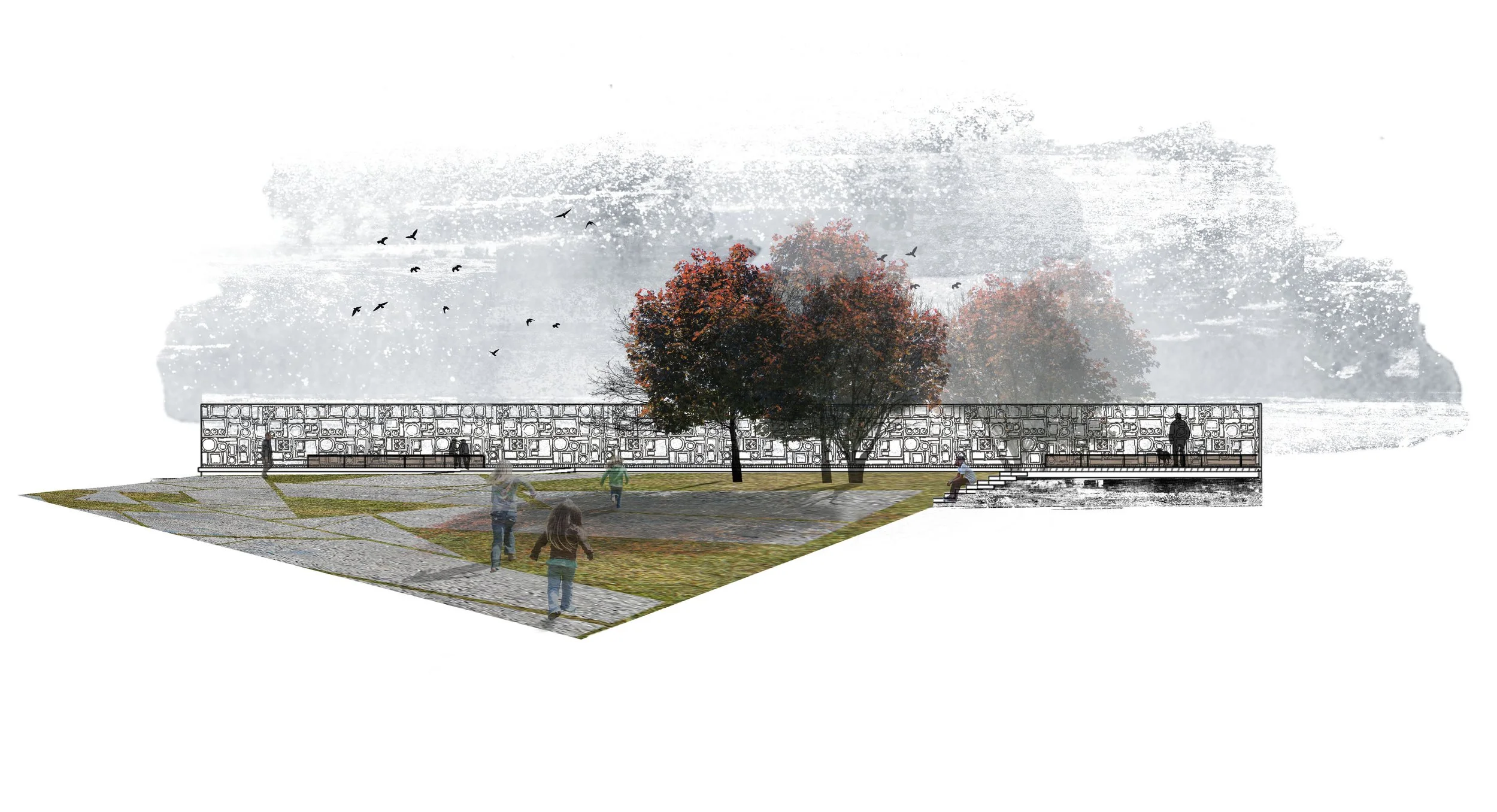
UNIVERSITY CITY PARK
April 2016
University City is a jurisdiction within the City of St Louis, Missouri. It has a Mayor, six council members and a City Manager. U-City, as it is known, is located on Olive Boulevard, not far from Washington University in St Louis. Developed along the principles of the City Beautiful movement, it is a community of around 40,000 people who live in a treed, largely middle class suburb that is changing rapidly as its population diversifies.
In recent years University City has been incorporating public art as a key component within its development strategy, both as a cultural signifier and as a means to cultivate identification with specific place by the community. U-City sees this initiative as fostering the advancement of economic and social objectives.
In partnership with the Sam Fox School of Design and Visual Arts, U-City developed a proposal called Art, Ecology, Community, that sought to encourage placemaking and economic development through framework of linked public landscape/art interventions across the City.
Given U-City’s emphasis on public art, an interesting issue arises for landscape architects: how might making landscape in a public art context change our perspectives both on landscape and on art? And what might the criteria of evaluation be for landscape artefacts that operate both as artworks and as generators of new social conditions? This project explores an emergent field within art and design that blurs the boundaries between types of practice and investigates the possibility of new social ecologies through the disturbance of traditional cultures of urbanism.
A new park was envisaged at a busy intersection on Olive Boulevard, that would enshrine the principles behind the Art, Ecology, Community initiative and kickstart the years-long project.
Rod Barnett was commissioned to develop a design for the park. He presented the City with two options, Crack-Up and Slinky, that each offered quite different amenity features while at the same time encouraging community adoption of the ideas behind the larger City project.
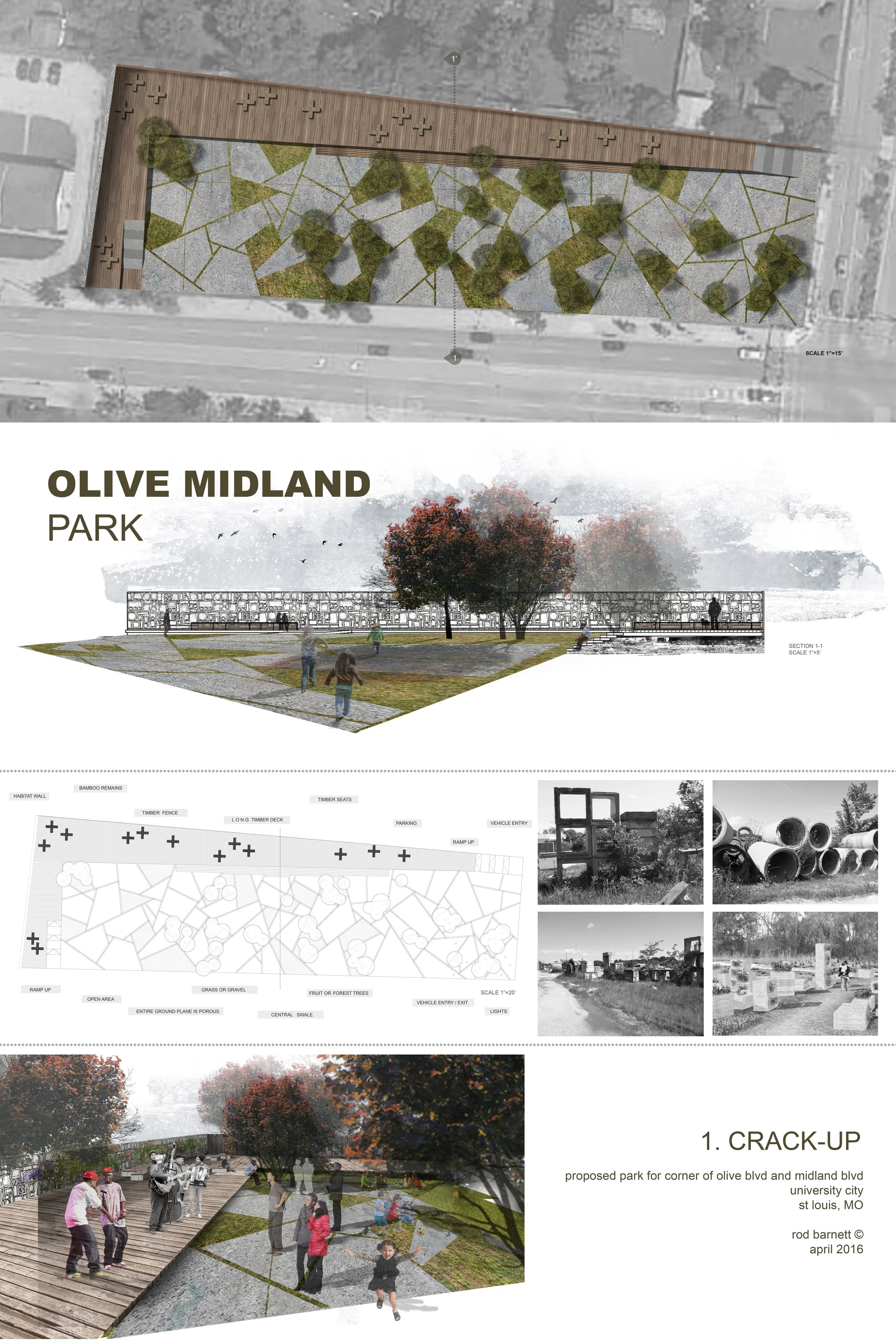
Crack -Up
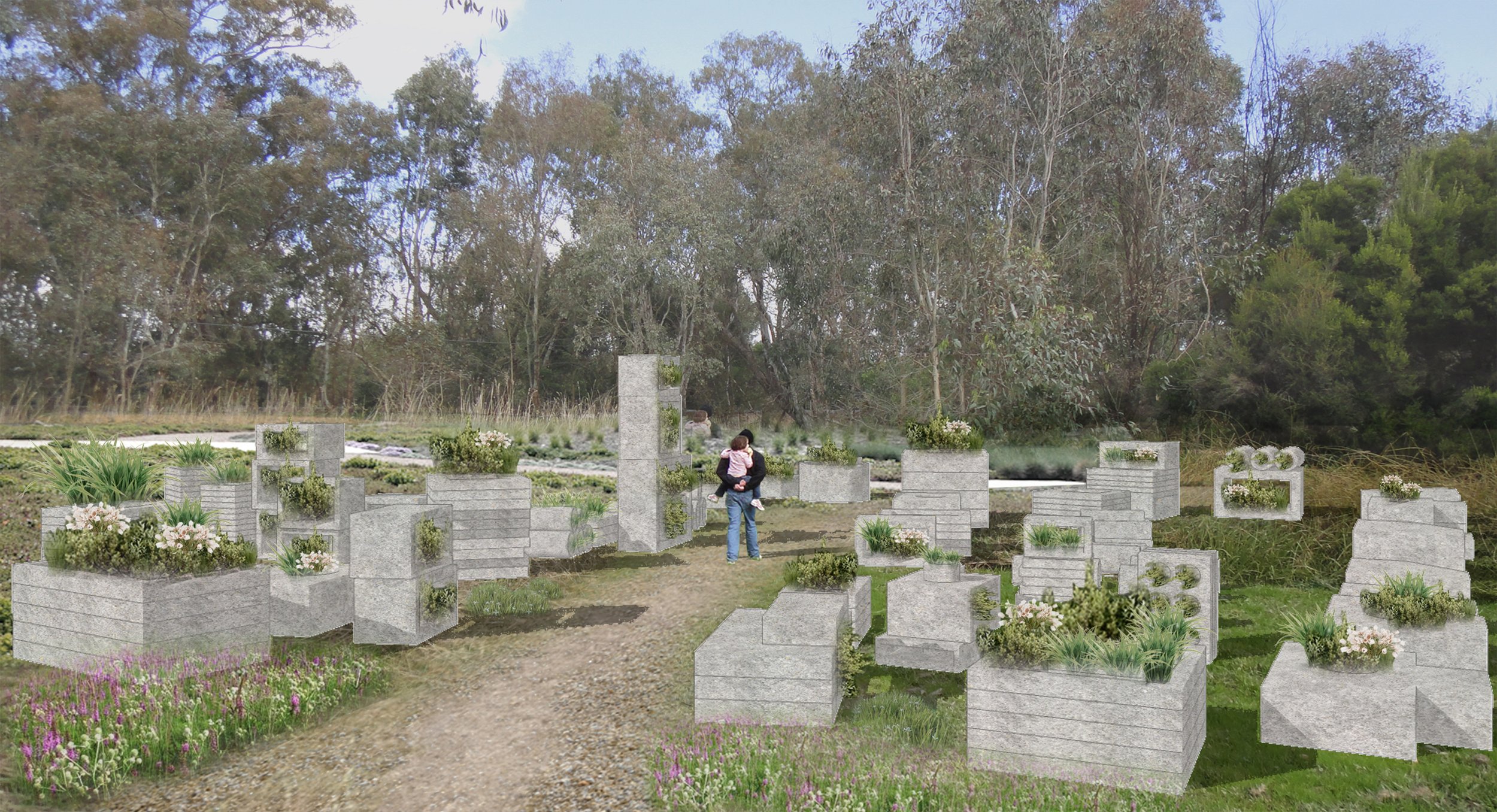
Ongoing demolition of 20th century urban sites in St Louis yields a great deal of concrete in the form of slabs and paved surfaces. Sites are marked up and the concrete removed and re-established as the floor of the proposed park, with groundcovers in the interstices and shade trees located at strategic positions within the overall pattern. The internal boundaries are enclosed and a deck formed along these boundaries with seating in the form of plus signs. The western boundary is developed as a Habitat Wall made from concrete units (boxes, slabs, square and round pipes) found at a City storage site. This wall becomes its own ecosystem of plants, insects and birds, a community within a community. It forms the backdrop to a stage.
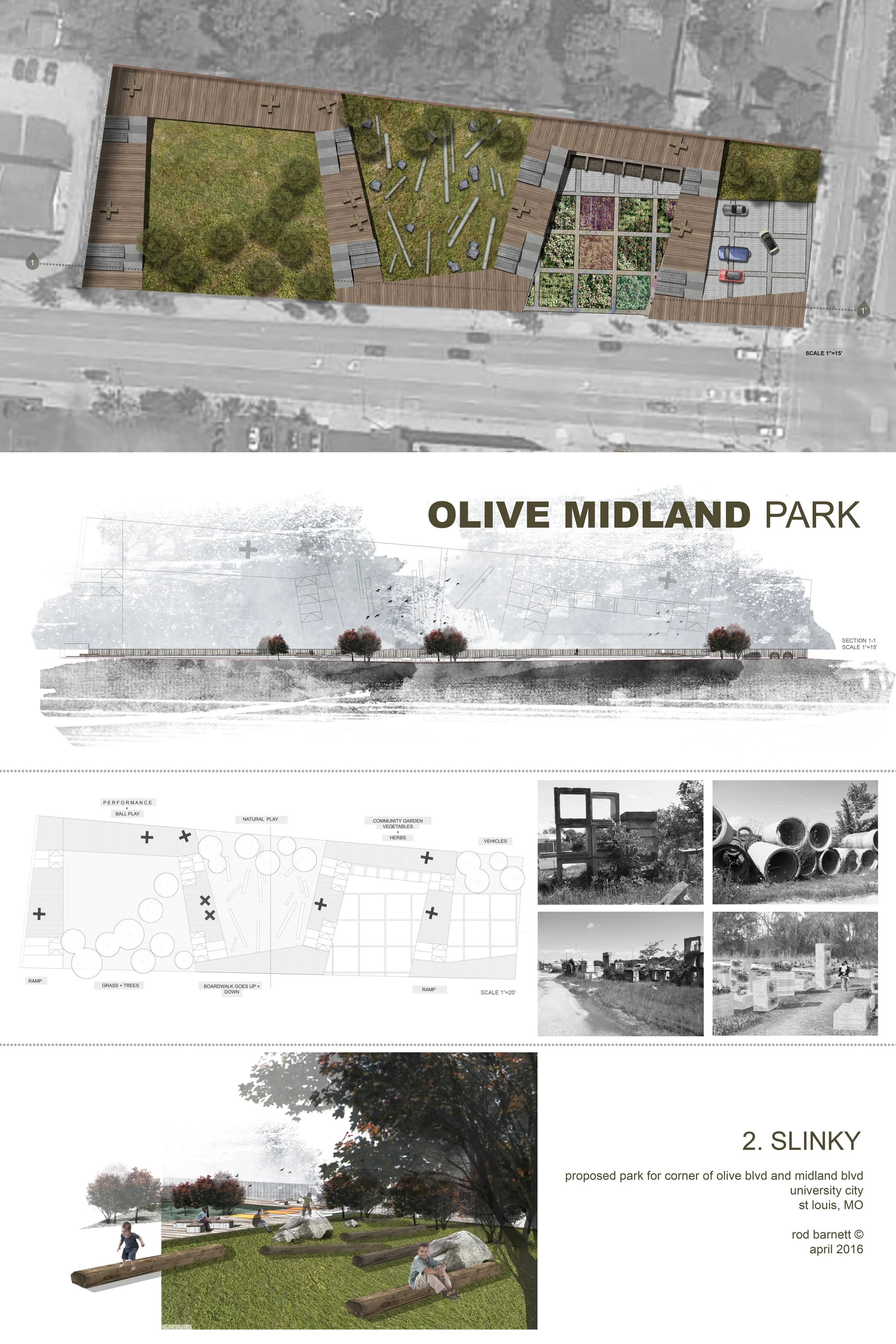
Slinky
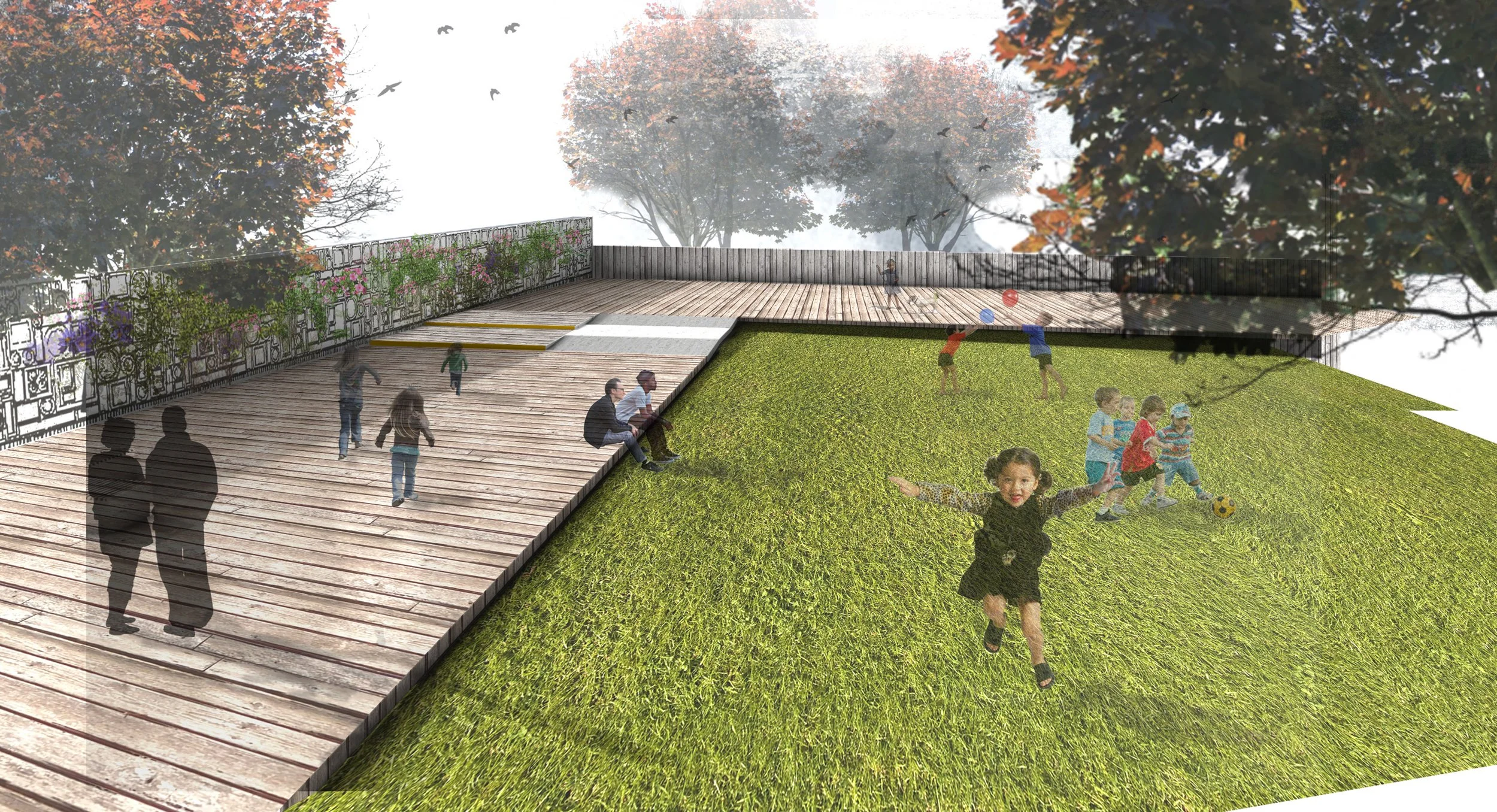
In this alternative proposal a deck winds across the site forming discrete zones: a mini-park, a children’s play area, a community garden and an offroad parking lot for service vehicles. The west boundary condition remains as a Habitat Wall. Acting as a bridge and a seating zone, the deck provides visual and physical access to the different components of the park. The thematic here is production. Compost bins serve the herb and vegetable garden and provide mulch for the trees. Vegetables can be sold, exchanged or gifted to the community from a monthly market in the parking lot.